
Complete Guide to Applications, Requirements, English Levels and Opportunities
What's your English level?
Take the test and get your certificate!

Erasmus is one of the most popular international education and mobility programmes in Europe. Every year, thousands of students, young people, graduates, teachers and professionals take part in opportunities that allow them to study, train, volunteer or participate in international projects abroad. But applying for Erasmus can also raise many questions.
What exactly is Erasmus? Do you need to be a university student? Is Erasmus an internship programme? Which countries participate? What English level do you need? How do you prepare your Erasmus CV and motivation letter?
Quick Answer: Erasmus is a European programme that supports education, training, youth mobility and international cooperation. The programme is widely known for giving university students the opportunity to study abroad, but Erasmus opportunities are not limited to studying at another university.

This guide answers the most important questions about the Erasmus programme and explains how you can prepare for an Erasmus application, including checking whether your current English level is suitable for studying or participating in an international programme.
What Is Erasmus?
Erasmus is a European programme that supports education, training, youth mobility and international cooperation. The programme is widely known for giving university students the opportunity to study abroad, but Erasmus opportunities are not limited to studying at another university.
Depending on the specific programme or project, Erasmus may include:
- University study exchanges
- International internships and traineeships
- Youth exchanges
- Volunteering opportunities
- Training programmes
- Teacher and staff mobility
- International projects and partnerships
- Non-formal learning activities
The current programme is generally known as Erasmus+, which brings together a wide range of education, training, youth and sport initiatives.
The exact application process, eligibility criteria and requirements may vary depending on whether you are applying through a university, organisation, youth project or another participating institution.
For official and up-to-date information about Erasmus+ opportunities, you can visit the official Erasmus+ website.
What Do You Need for Erasmus?
The requirements depend on the type of Erasmus opportunity you are applying for. However, applicants will often need some combination of the following:
- Eligibility through a university, school or participating organisation
- A completed Erasmus application
- Academic records or transcripts
- A CV or résumé
- A motivation letter
- Proof of identity or passport information
- Sufficient language skills
- Acceptance from a host institution or organisation
- Additional documents requested by the specific programme
For university exchange programmes, your academic performance and eligibility requirements may also be considered.
One important point is that there is no single Erasmus requirement that applies to every applicant in every country. Your university or the organisation managing the project will usually provide the exact eligibility criteria.
What Is Erasmus Youth Exchange Programme?
An Erasmus Youth Exchange is an international programme that brings together young people from different countries to learn, collaborate and participate in activities around a specific topic.
Unlike a traditional university exchange, a Youth Exchange is generally based on non-formal learning.
Participants may take part in activities such as:
- Workshops
- Group discussions
- Cultural activities
- Team projects
- Outdoor activities
- Presentations
- Intercultural learning
- Problem-solving exercises
Youth Exchanges can focus on many different topics, including sustainability, entrepreneurship, digital skills, inclusion, culture, mental wellbeing, employment and active citizenship.
Participants usually come from multiple countries, which means English often becomes an important communication tool during the programme.
You may not need to be a university student to participate in an Erasmus Youth Exchange. Eligibility depends on the project, the participating organisations and the target age group.
For example, one project may be designed for participants aged 18–25, while another may accept a wider age range.
If you are applying for an international Youth Exchange, you should carefully check the specific project requirements before applying.
You can learn more about Erasmus+ youth opportunities through the Erasmus+ Youth section.
How to Prepare an Erasmus CV
An Erasmus CV should clearly explain who you are, what you have studied or worked on and why you may be a suitable candidate for the opportunity.
If you are a student or recent graduate, you do not need to have years of professional experience. Your academic background, projects, volunteer work, international experience, skills and extracurricular activities can all be relevant.
A typical Erasmus CV may include the following sections.
1. Personal Information
Include the basic information requested by the application.
This may include:
- Full name
- Email address
- Phone number
- City and country
- LinkedIn profile, if relevant
Avoid adding unnecessary personal information unless it is specifically requested.
2. Education
List your current or previous education.
Include:
- University or school name
- Degree or programme
- Field of study
- Dates of attendance
- Relevant academic achievements
If you are applying for an Erasmus university exchange, your current programme and academic background are particularly important.
3. Work Experience
Include relevant professional experience, internships or part-time jobs.
Try to focus on responsibilities and achievements rather than simply listing job titles.
For example:
Assisted an international marketing team with social media content and communication projects.
This gives the reader more information than simply writing:
Marketing Intern
4. Projects and Activities
If you do not have much professional experience, this section can be particularly useful.
Include:
- University projects
- Student clubs
- Volunteering
- International activities
- Competitions
- Personal projects
- Erasmus or exchange experience
5. Skills
Include relevant skills such as:
- Communication
- Teamwork
- Leadership
- Digital skills
- Project management
- Research
- Problem-solving
6. Languages
Clearly list the languages you speak and your approximate level.
For example:
- Turkish: Native
- English: B2 Upper-Intermediate
- German: A2 Elementary
If your Erasmus application requires you to demonstrate your English ability, you may also need to provide a language certificate or complete a language assessment.
Before describing your English level on your CV, it can be useful to take an English proficiency test and compare your result with the CEFR levels from A1 to C2.
Erasmus Motivation Letter Example
A motivation letter is your opportunity to explain why you want to participate in an Erasmus programme and what you hope to gain from the experience.
A strong Erasmus motivation letter should not simply repeat your CV.
Instead, it should answer questions such as:
- Why do you want to join this programme?
- Why are you a suitable candidate?
- What do you hope to learn?
- How does the programme relate to your academic or professional goals?
- What can you contribute to the international group or host institution?
Erasmus Motivation Letter Example
Dear Selection Committee,
I am writing to express my interest in participating in the Erasmus programme at [Host University or Organisation].
As a student of [Your Subject] at [Your University], I am interested in developing both my academic knowledge and international experience. I believe that studying and collaborating in an international environment would help me improve my communication skills, develop a broader perspective and learn from people with different cultural and educational backgrounds.
One of my main reasons for applying for Erasmus is the opportunity to challenge myself outside my usual environment. I am particularly interested in [specific academic area, project or opportunity], and I believe that participating in this programme would contribute to my future academic and professional goals.
I would also be happy to contribute my own experiences, perspective and skills to the international community. I enjoy working with people from different backgrounds and believe that collaboration and cultural exchange can create valuable learning experiences for everyone involved.
I am motivated, adaptable and willing to take responsibility for making the most of this opportunity. I believe that the Erasmus experience would help me grow both personally and professionally.
Thank you for considering my application.
Yours sincerely,
[Your Name]
How to Improve Your Erasmus Motivation Letter
Before submitting your letter:
- Adapt it to the specific programme
- Avoid copying generic motivation letter templates word for word
- Explain your personal reasons for applying
- Connect Erasmus with your future goals
- Check grammar and spelling carefully
- Keep the tone professional but personal
- Make sure your English level allows you to express your ideas clearly
A motivation letter does not need to use extremely complicated English. Clear, natural and well-structured writing is usually more effective than unnecessarily complex vocabulary.
Which English Level Is Required for Erasmus?
There is no single English level requirement for every Erasmus programme.
The required level can depend on:
- Your university
- The host university
- The language of instruction
- The country
- The specific Erasmus project
- The type of mobility programme
For programmes taught in English, B1 or B2 English is commonly requested, depending on the institution and programme.
However, some academic programmes may require a higher level, particularly when students are expected to:
- Attend university lectures in English
- Write academic essays
- Participate in seminars
- Complete presentations
- Work in international teams
- Take written examinations
Is B1 English Enough for Erasmus?
B1 English may be sufficient for some programmes, especially when the formal language requirement is lower or when English is mainly used for everyday communication. At B1 level, you can generally understand and communicate about familiar topics and participate in everyday conversations. However, studying at university in English may be challenging at B1 level, particularly when academic writing, lectures and complex discussions are involved.
Is B2 English Good Enough for Erasmus?
B2 is often considered a stronger level for participating in an international academic environment.
At B2 level, learners are generally able to:
- Understand more complex texts
- Participate in discussions
- Communicate with greater fluency
- Explain opinions and ideas
- Follow longer conversations and presentations
If your Erasmus programme involves studying in English, B2 may provide a more comfortable starting point than B1.
Do You Need C1 English for Erasmus?
C1 is not universally required for Erasmus.
However, some universities or academically demanding programmes may request C1-level English, especially for advanced courses or programmes with significant academic writing requirements.
Always check the exact language requirements of the university or organisation you are applying to.
Erasmus English Test: Check Your English Level with Global English Test
Before applying for an Erasmus programme, it can be useful to understand your current English level.Your application may require you to communicate with universities, write a motivation letter, prepare a CV, attend an interview or study in an English-speaking academic environment.
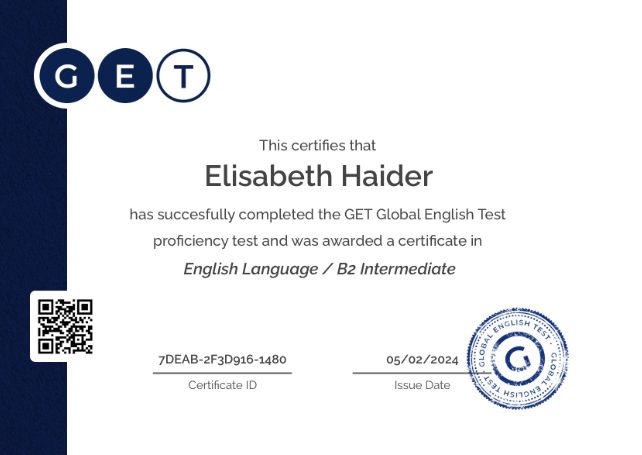
Global English Test (GET) allows you to assess your English proficiency and receive a result based on the internationally recognised CEFR framework.
The CEFR framework divides English proficiency into six main levels:
- A1: Beginner
- A2: Elementary
- B1: Intermediate
- B2: Upper-Intermediate
- C1: Advanced
- C2: Proficient
Taking an English level test before your Erasmus application can help you understand whether your current level is likely to be sufficient for your goals. For example, if you are targeting a university that expects B2 English, knowing whether your current level is closer to B1, B2 or C1 can help you identify whether you need additional preparation.
You can take the Global English Test to check your English level and receive a CEFR-based result.
Take the Global English Test and check your English level for Erasmus
Please note that Erasmus universities and organisations may have their own rules regarding accepted language certificates. Always check whether the institution specifically requires IELTS, TOEFL, Cambridge English qualifications or another officially accepted test. The GET result can be useful for understanding and demonstrating your current English level, but applicants should always verify the official language requirements of the specific Erasmus programme before applying.
Erasmus Logo
The Erasmus logo and visual identity are associated with the Erasmus+ programme and European cooperation in education, training, youth and sport.If you are preparing an Erasmus project, presentation, website or promotional material, you should be careful when using official Erasmus or European Union branding.

The use of official logos may be subject to specific visual identity and communication guidelines.Do not assume that every Erasmus-related project can freely modify or reproduce official logos for commercial or promotional purposes.
For the most accurate information, check the official Erasmus+ communication and branding resources provided by the programme.
Is Erasmus an Internship Programme?
Erasmus is not only an internship programme. Erasmus includes several different types of mobility and international learning opportunities. The best-known option is university study abroad, where students spend a period of time studying at a partner university in another country. However, Erasmus opportunities may also include traineeships or internships.
An Erasmus traineeship can allow eligible participants to gain work experience in another country. Depending on the programme, participants may work with:
- Companies
- Startups
- Research organisations
- NGOs
- Educational institutions
- Other eligible organisations
The specific requirements, duration and funding conditions can vary. So, if you are asking, “Is Erasmus an internship?”, the answer is: Erasmus can include internships and traineeships, but Erasmus itself is a much broader international education and mobility programme.
How to Make an Erasmus Application
The Erasmus application process depends on the opportunity you are applying for. If you are applying for a university exchange, the process will usually begin with your own university. A typical application process may look like this.
Step 1: Check Whether You Are Eligible
First, check whether your university or organisation participates in the relevant Erasmus programme. Review:
- Academic eligibility
- Minimum grades or GPA requirements
- Study year requirements
- Citizenship or residency requirements
- Language requirements
- Application deadlines
Step 2: Choose Your Destination or Programme
You may need to select one or more:
- Universities
- Countries
- Erasmus projects
- Internship opportunities
- Youth exchanges
Research the academic programme, courses, language of instruction and living conditions before making your choice.
Step 3: Prepare Your Documents
You may need documents such as:
- Application form
- CV
- Motivation letter
- Academic transcript
- Passport or ID
- Language certificate
- Learning agreement
- Other documents requested by your university
Step 4: Submit Your Application Before the Deadline
Erasmus deadlines can vary significantly.
Do not assume that every university follows the same calendar.
Check the deadline through your university’s international office or the organisation responsible for the programme.
Step 5: Wait for the Selection Process
Your application may be evaluated based on criteria such as:
- Academic performance
- Motivation
- Language skills
- Available places
- Programme-specific requirements
If you are selected, you may then need to complete additional documentation before travelling.
What Are the Requirements for Erasmus Acceptance?
Erasmus acceptance requirements depend on the programme, but applicants may be evaluated based on several factors.
Academic Eligibility
University exchange applicants may need to meet a minimum academic performance requirement.
Your university may consider:
- GPA
- Completed credits
- Current year of study
- Academic progress
Language Skills
You may need to demonstrate sufficient ability in:
- English
- The language of instruction
- The local language, in some cases
The required level may range from B1 to C1 depending on the programme.
Available Places
Even if you meet the minimum requirements, selection may depend on the number of available places.
Popular universities and destinations may receive more applications than available positions.
Application Documents
Incomplete or incorrectly prepared applications may affect your chances.
Make sure your documents are accurate, complete and submitted before the deadline.
Motivation
Some Erasmus opportunities may consider why you want to participate.
A clear and specific motivation letter can help demonstrate that you understand the opportunity and have realistic goals.
Which Universities Offer Erasmus Programmes?
Thousands of universities and higher education institutions across Europe and partner countries participate in Erasmus+ activities.
However, you cannot necessarily apply to every university directly.
University exchanges are usually based on agreements between your home university and specific partner institutions.
For example, your university may have Erasmus agreements with universities in:
- Germany
- Spain
- Italy
- France
- Netherlands
- Poland
- Portugal
- Turkey
- Belgium
- Other participating countries
The list of available universities can vary depending on your department or field of study.

The best place to start is usually your university’s:
- International Office
- Erasmus Office
- Exchange Programme Office
- International Relations Department
Ask for the current list of Erasmus partner universities available for your programme.
Which Countries Offer Erasmus Programmes?
Erasmus+ includes opportunities across many European countries and, depending on the action or programme, additional partner countries.
Popular Erasmus destinations include:
- Germany
- Spain
- Italy
- France
- Netherlands
- Portugal
- Poland
- Belgium
- Austria
- Czech Republic
- Greece
- Hungary
- Sweden
- Finland
- Denmark
- Ireland
The exact countries and institutions available to you will depend on your university or the specific Erasmus project.
Not every student will have access to the same destinations.
Your available options may depend on:
- Your university’s partnerships
- Your academic department
- The type of Erasmus programme
- Available funding
- Current programme rules
Always check the latest information with your university or through the official Erasmus+ resources before applying.
Frequently Asked Questions About Erasmus
What is Erasmus?
Erasmus is an international programme that supports education, training, youth mobility and international cooperation. It can include university exchanges, internships, youth exchanges and other international learning opportunities.
Do I need to be a university student to join Erasmus?
Not always. Some Erasmus opportunities, such as Youth Exchanges, may be available to young people through participating organisations without requiring university enrolment.
Is Erasmus free?
The financial conditions depend on the programme. Participants may receive grants or financial support, but the exact amount and coverage vary depending on the country, programme and individual circumstances.
What English level do I need for Erasmus?
There is no single requirement. B1, B2 or C1 may be required depending on the university, programme and language of instruction. B2 is commonly considered a useful level for studying and communicating in an international academic environment.
Is B1 enough for Erasmus?
B1 may be sufficient for some programmes, but it may be challenging for university-level study in English. Always check the specific requirement of the host institution.
Is B2 enough for Erasmus?
B2 is often a suitable level for many programmes taught in English, but the exact requirement depends on the university or organisation.
Do I need IELTS for Erasmus?
Not necessarily. Some universities may accept other language qualifications or assessments. Others may specifically require IELTS, TOEFL or another recognised certificate. Always check the requirements of the institution you are applying to.
Can I do an Erasmus internship?
Yes. Erasmus can include traineeships and internship opportunities, depending on your eligibility and the available programme options.
How long does Erasmus last?
The duration depends on the type of mobility and the specific programme. Study exchanges, traineeships and youth projects can have different durations.
Can I choose any Erasmus country?
Usually, you can only choose from destinations and partner institutions available through your university or the organisation managing your programme.
How do I apply for Erasmus?
For university exchanges, you should usually begin by contacting your university’s Erasmus or International Office. For Youth Exchanges and other projects, applications may be handled by participating organisations.
How can I check if my English is good enough for Erasmus?
Start by checking the official language requirement of the university or programme you want to join. Then assess your current English level against the CEFR framework.
You can take the Global English Test (GET) to understand whether your current English level is around A1, A2, B1, B2, C1 or C2.
Knowing your current level can help you decide whether you are ready to apply or whether you should spend more time improving your English before beginning your Erasmus experience.
Ready to Check Your English Level for Erasmus?
Your Erasmus experience may involve studying, working, travelling and communicating with people from many different countries. Understanding your current English level before you apply can help you prepare with more confidence.
Take the Global English Test to assess your English level and see where you stand on the CEFR scale from A1 to C2.



