
What Is Reading Comprehension?
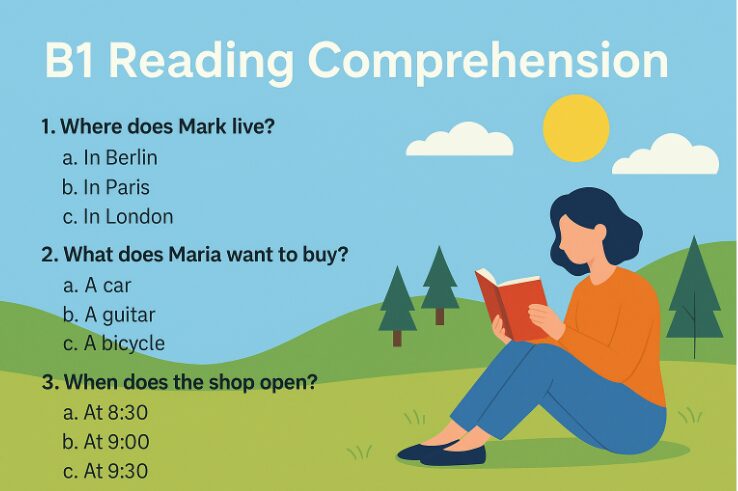
Reading comprehension is the ability to understand, interpret, and respond to written text. At the B1 (intermediate) level, learners are expected to handle everyday topics, recognize opinions and main ideas, and extract key details from articles, emails, or short stories.
What's your English level?
Take the test and get your certificate!

Who Is It For?
B1 Reading Comprehension is ideal for:
- Intermediate English learners (CEFR B1 level)
- Learners preparing for a reading component of an English exam, alongside official practice materials for their specific test
- Travelers, professionals, or learners aiming for functional fluency in English
What Can You Expect from a B1 Reading Test?
| Section | Description |
|---|---|
| Short Texts | Notices, emails, blog excerpts, or informal letters |
| Comprehension Questions | Multiple-choice, true/false, or matching headings |
| Skills Tested | Understanding opinions, recognizing cause-effect, identifying key information |
How to Improve B1 Reading Comprehension?
- Read a Little Every Day
Blogs, news stories, emails, and simplified books - Underline Keywords
Helps focus on main ideas and supporting details - Guess Vocabulary from Context
Don’t use a dictionary for every word: train your brain - Practice with Past Tests
Use real test samples for PET or IELTS General Training - Summarize What You Read
Retell the main idea in 1–2 sentences
Sample Vocabulary for B1 Reading
| Word | Meaning |
|---|---|
| advice | suggestion or guidance |
| prefer | to like something more |
| journey | a trip or travel |
| solve | to find an answer |
| explain | to describe clearly |
A B1 Reading Practice: The Saturday Repair Cafe
Read the original practice text once for the main idea. Then answer the six questions and underline the words that support each answer. The activity practises detail, purpose and inference; its score is not a CEFR assessment.
The Saturday Repair Cafe
When the library announced a repair cafe, Maya thought it would be a place to buy second-hand things. In fact, the organisers wanted people to bring broken objects and learn how to repair them. The event would take place on the first Saturday of each month. There was no charge, although visitors could leave a donation to help pay for tools.
Maya took a small lamp that had stopped working. She arrived at ten, but all the volunteers were already busy, so she waited for twenty minutes. A volunteer called Ben showed her how to check the lamp safely. He discovered that a loose connection was causing the problem. Instead of doing everything himself, he asked Maya to help with each step.
By lunchtime, the lamp was working again. Maya was pleased to save money, but she was even happier about learning a useful skill. Before leaving, she put her name on a list to help at the next event. She could not repair electrical objects alone yet, so she offered to welcome visitors and organise the waiting area.
Questions
What is the main purpose of the repair cafe?
A) To sell used objects
B) To help people repair things and learn
C) To collect new books for the libraryHow often is the event planned?
A) Every Saturday
B) Once a month
C) Once a yearWhy did Maya have to wait?
A) The volunteers were helping other people
B) She had forgotten her lamp
C) The library had not openedWhat does “each step” refer to in the second paragraph?
A) The stages of checking and repairing the lamp
B) The stairs outside the library
C) The dates of future eventsWhich result mattered most to Maya?
A) Buying a new lamp
B) Getting a paid job
C) Learning something usefulWhy did Maya offer to welcome visitors instead of repairing electrical objects?
A) She disliked working with Ben
B) She wanted to help but still needed more repair experience
C) The organisers refused to provide tools
Show the answers and evidence
| Question | Answer | Evidence and explanation |
|---|---|---|
| 1 | B | The organisers want visitors to bring broken objects and learn to repair them. Selling objects was Maya’s first, mistaken idea. |
| 2 | B | “The first Saturday of each month” means one planned event per month, not every Saturday. |
| 3 | A | “All the volunteers were already busy” explains the twenty-minute wait. |
| 4 | A | Ben is checking the lamp and explaining the repair. In that context, a step is a stage of the task. |
| 5 | C | She is “even happier about learning a useful skill” than about saving money. |
| 6 | B | She cannot repair electrical objects alone yet. Welcoming visitors lets her contribute while she is still learning. |
Review the reason for each mistake before trying another text. If you chose an answer because it repeated a familiar word, check whether the whole sentence supports it. For question 6, combine the final two sentences rather than looking for one identical phrase.
B1 Reading Comprehension Mini Quiz (3 Questions)
Text:
Lisa is planning a weekend trip to the countryside. She wants to relax, take long walks, and read her favorite book. She checks the weather forecast and sees that it might rain on Saturday but will be sunny on Sunday. She decides to bring an umbrella just in case.
Question 1:
What does Lisa want to do during the weekend?
A) Go shopping in the city
B) Visit her grandparents
C) Relax and take walks
D) Work from home
Answer: C) Relax and take walks
Question 2:
Why does Lisa take an umbrella?
A) It is already raining
B) She wants to avoid the sun
C) It might rain on Saturday
D) She forgot her raincoat
Answer: C) It might rain on Saturday
Question 3:
What is the weather like on Sunday?
A) Windy
B) Rainy
C) Sunny
D) Cold
Answer: C) Sunny
What's your English level?
Take the test and get your certificate!




