You know how a knight moves, but can you explain it in English? Chess vocabulary helps you follow a lesson, discuss a position and understand why a commentator calls a move a fork, a blunder or a brilliant sacrifice. This guide connects the essential terms with clear meanings, natural example sentences and a short quiz, so you can use the language as well as recognise it.
The six chess piece names in English are king, queen, rook, bishop, knight and pawn. Start with these, then learn board words such as square, rank and file, action words such as move and capture, and result words such as checkmate, stalemate and draw. Practise complete phrases: “It is your turn,” “My king is in check” and “The game ended in a draw.”
What's your English level?
Take the test and get your certificate!

Chess Pieces in English: Names, Movements and Pronunciation
A standard chess game begins with 16 pieces for each player: one king, one queen, two rooks, two bishops, two knights and eight pawns. The table describes their basic movements; every move must also leave your own king safe. Special moves appear later in the guide.
| Piece | Movement and example |
|---|---|
| King | Moves one square in any direction, without entering an attacked square. “Keep your king safe.” |
| Queen | Moves any number of squares along a rank, file or diagonal, without jumping over pieces. “The queen attacks along the diagonal.” |
| Rook | Moves any number of squares horizontally or vertically, without jumping. “Move the rook to the open file.” |
| Bishop | Moves any number of squares diagonally, without jumping. “My bishop stays on light squares.” |
| Knight | Moves in an L shape: two squares in one direction and one at a right angle. It can jump over other pieces. “The knight jumps over the pawn.” |
| Pawn | Normally advances one square towards the opponent’s side and captures one square diagonally forwards. From its starting square, it may advance two squares if both are empty. “The pawn captures diagonally.” |
Unlike a knight, a rook cannot jump over a piece blocking its path. A pawn cannot move backwards, and its normal forward move must land on an empty square. These differences make the verbs move, jump and capture useful words to learn together.
Say “knight” like “night”
The k in knight is silent, so the word sounds exactly like night. Rook rhymes with book, and bishop has two syllables with stress on the first: BISH-up. The standard English name of the horse-shaped piece is knight.
Piece can mean any chessman, including a pawn. In analysis, players also use it more narrowly: “I won a piece” commonly means winning a knight or bishop. The context tells you which meaning is intended.
The Chessboard: Squares, Ranks, Files and Directions
A chessboard has 64 squares arranged in eight rows and eight columns. With White’s side nearest you, the files run from a on the left to h on the right, and the ranks run from 1 at the bottom to 8 at the top. Each square has a coordinate, such as e4.
| Term | Meaning and example |
|---|---|
| Square | One space on the board. “Place the knight on f3.” |
| Rank | A horizontal row. “The rook reached the seventh rank.” |
| File | A vertical column. “Both rooks are on the d-file.” |
| Diagonal | A sloping line of squares of the same colour. “The bishop controls a long diagonal.” |
| Centre | The central area, especially d4, e4, d5 and e5. “Fight for control of the centre.” |
| Kingside / queenside | The e- to h-files / the a- to d-files. “Black is attacking on the kingside.” |
| Position | The arrangement of pieces and the relevant game situation. “Let’s analyse this position.” |
Use on for a piece’s location: “The bishop is on c4.” Use to for its destination: “Move the bishop to c4.” To describe its path, say “The rook moves along the rank” or “The bishop moves diagonally.”
Try this speaking exercise on an otherwise empty board: put a rook on d4 and describe where it can move. “It can move along the fourth rank or up and down the d-file.” Add a blocking piece and explain what changes.
Moves and Useful Chess Verbs
You play chess and make a move. Your turn is your opportunity to move, while your opponent is the person playing against you. “White to move” means it is White’s turn.
| Verb or phrase | Meaning and example |
|---|---|
| Capture / take | Remove an opposing piece by taking it according to the rules. “My bishop captured your knight.” In conversation: “My bishop took your knight.” |
| Attack | Threaten an opposing piece or exert attacking power over a square. “The rook attacks the queen.” |
| Defend / protect | Support a piece or guard against a threat. “The pawn defends the bishop.” |
| Develop | Bring pieces, especially knights and bishops, into active play. “Develop your knights before moving the same piece again.” |
| Exchange / trade | Capture material and allow material to be captured in return. “We exchanged queens.” |
| Sacrifice | Deliberately give up material for an expected benefit. “She sacrificed a bishop to attack the king.” |
| Threaten | Create a possibility the opponent may need to prevent. “This move threatens checkmate.” |
| Resign | Concede the game. “He resigned after losing his queen.” |
Material refers to the pieces and pawns considered as resources. “I am a pawn up” means I have an extra pawn compared with my opponent; “I am a rook down” describes the opposite kind of disadvantage. Having more material does not by itself guarantee victory.
Check, Checkmate, Stalemate and Draw: What Is the Difference?
These terms describe different situations, so they are not interchangeable. The key questions are whether the king is attacked and whether the player whose turn it is has a legal move. A legal move is a move permitted by the rules.
| Term | Meaning |
|---|---|
| Check | The king is under attack. The player must remove that attack with a legal move. |
| Checkmate | The king is in check and there is no legal move that removes the check. The game ends with a win for the player delivering mate. |
| Stalemate | The player to move has no legal move with any piece, but their king is not in check. The game is a draw. |
| Draw | A game result in which neither player wins. Stalemate is one way a draw can occur. |
A king that cannot move is not necessarily stalemated: its player may still have a legal pawn or piece move. Likewise, check is not automatically checkmate. Depending on the position, you may escape check by moving the king, capturing the attacker or blocking the attack.
Say “Your king is in check,” “That is checkmate” or “The game ended in a draw.” The king is never captured in a legal game of chess. The FIDE Laws of Chess, particularly Articles 3 and 5, explain these rule distinctions and the special moves below.
Special Moves: Castling, Promotion and En Passant
Castling
Castling is a single move involving the king and one rook. In standard chess, the king moves two squares towards that rook, and the rook moves to the square the king crossed. Players say “castle kingside” or “castle queenside.”
The king and the chosen rook must never have moved, and the squares between them must be empty. The king cannot castle while in check, through an attacked square or onto an attacked square. Simply moving a king or rook back to its starting square does not restore the right to castle.
Promotion
A pawn that reaches the farthest rank is immediately replaced by a queen, rook, bishop or knight of the same colour. This is called promotion; the verb phrase is “promote a pawn.” The choice does not depend on which pieces have previously been captured.
“She promoted her pawn to a queen” describes a common choice. Choosing a rook, bishop or knight instead is called underpromotion. You cannot promote a pawn to a king.
En passant
En passant is a special pawn capture. If an opposing pawn advances two squares from its starting square and lands beside your pawn on the same rank, your pawn may capture it as though it had advanced only one square. You must make this capture on your very next move or lose that opportunity.
For example, a white pawn on e5 can capture a black pawn that has just moved from d7 to d5 by moving to d6. The black pawn is removed from d5. The expression comes from French and means “in passing.”
Chessoku: A Must-Try Puzzle Game for Chess Fans
If you enjoy chess, Chessoku is a game you should definitely try. It combines familiar chess-piece movements with number-based logic puzzles on a compact board. Each numbered clue tells you how many pieces attack that square, and your challenge is to place every piece so that all the counts match.
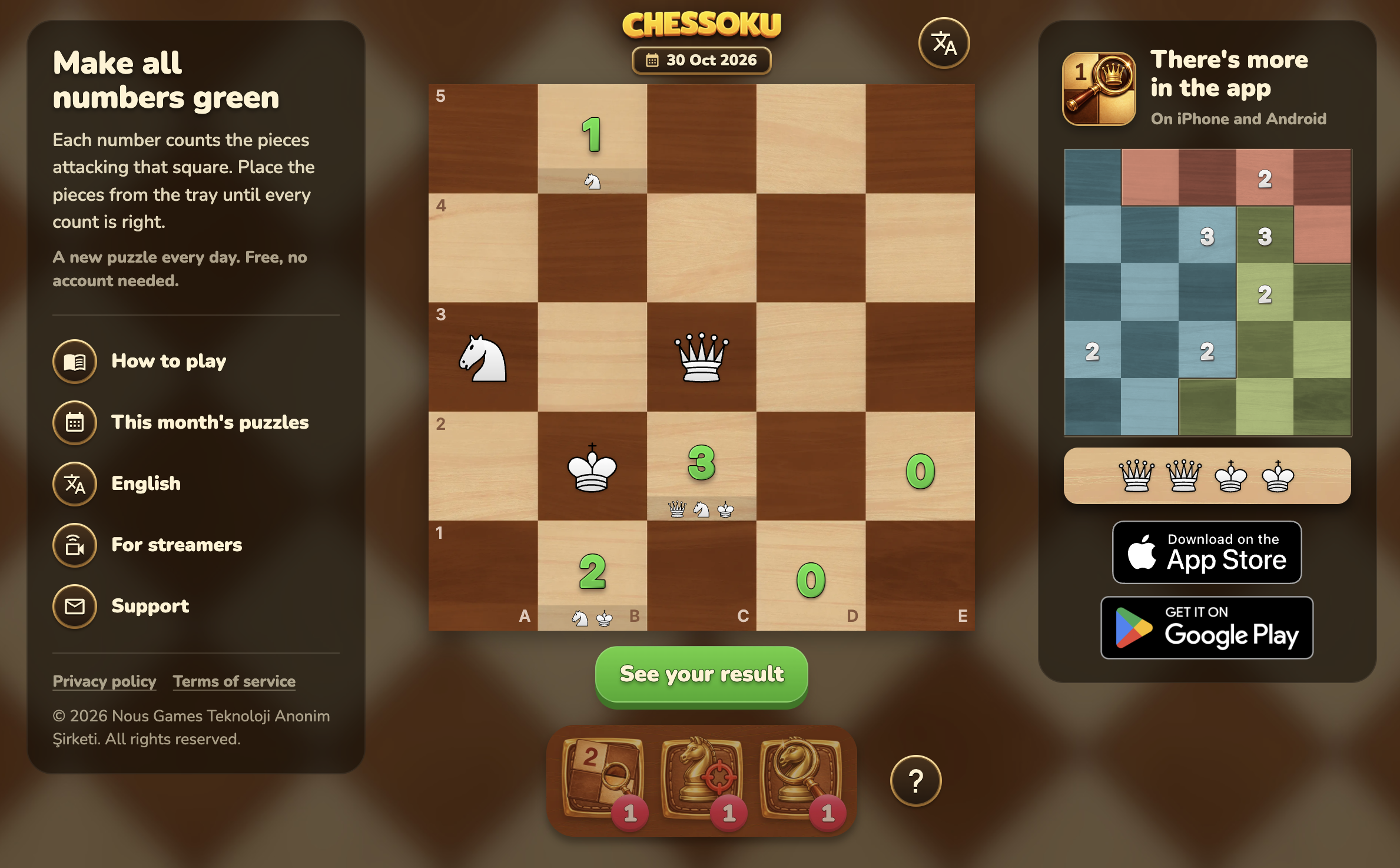
A square marked 2 must be attacked by exactly two pieces, while a 0 means no piece should attack it. Rooks, bishops, knights and queens each bring different possibilities to the puzzle. A blocking piece can change an entire line of attack, while a knight can jump over pieces in its way. Working out how the clues fit together gives the game its appeal: every placement matters.
With a progression of puzzles and a daily challenge, Chessoku gives chess fans a fresh way to enjoy the pieces and patterns they already love. You can focus on working out the board one clue at a time, then see how your choices affect the whole puzzle.
Play on the Chessoku website, or try Chessoku for iOS on the App Store or Chessoku for Android on Google Play and see whether you can solve the board.
Tactics, Strategy and the Stages of a Game
A tactic is a concrete sequence or idea used to achieve an immediate goal, such as winning material or delivering mate. Strategy concerns broader plans, such as improving piece activity or creating a weakness. A good explanation often connects them: “I improved my rook’s position, then found a tactic.”
Fork, pin and skewer
A fork occurs when one piece attacks two or more opposing pieces at once. For example, a knight might attack a king and a rook simultaneously. Knights are well known for forks, but other pieces, including pawns, can create them too.
A pin restricts a piece because moving it would expose something valuable behind it. If that target is the king, the pinned piece cannot legally make a move that exposes the king to check. A skewer reverses the arrangement: the more valuable piece is attacked in front, and moving it can expose the piece behind.
Compare the sentences “My bishop pins the knight to the king” and “My rook skewers the king and queen.” For illustrated positions, see Chess.com’s explanations of the fork, pin and skewer.
More terms you will hear in lessons
| Term | Meaning and example |
|---|---|
| Opening | The early stage of a game. “I developed both knights in the opening.” |
| Middlegame | The stage in which developed positions lead to plans, attacks and tactical play. “The middlegame became complicated.” |
| Endgame | The later stage, usually with fewer pieces remaining. “We reached a rook endgame.” |
| Blunder | A serious mistake. “Leaving my queen undefended was a blunder.” |
| Hanging piece | A piece left vulnerable to capture without adequate compensation. “I missed the hanging bishop.” |
| Gambit | An opening in which material is offered for an expected advantage. “Black accepted the gambit.” |
| Tempo | A unit of time measured in moves. “Attacking the queen helped me develop with tempo.” |
| Zugzwang | A position where having to move worsens your situation. “Any move loses the pawn; Black is in zugzwang.” |
These stages do not begin at a fixed move number. An early queen exchange does not automatically create an endgame, and a long opening does not guarantee a better position. Use the terms to describe what is happening on the board.
How to Read Basic Chess Notation in English
Notation is a system for recording moves. In English algebraic notation, K means king, Q queen, R rook, B bishop and N knight. Pawns have no initial letter, which is why a pawn move can be written simply as e4.
| Notation | Read it as |
|---|---|
| e4 | “Pawn to e4.” |
| Nf3 | “Knight to f3.” |
| Bxe5 | “Bishop takes on e5.” The x indicates a capture. |
| Qh7+ | “Queen to h7, check.” The + indicates check. |
| Qh7# | “Queen to h7, checkmate.” The # indicates mate. |
| 0-0 / 0-0-0 | “Castles kingside” / “castles queenside.” |
| e8=Q | “Pawn to e8, promoting to a queen.” |
These are separate notation examples, not a sequence of moves from one game. Castling is also commonly displayed as O-O and O-O-O, using the letter O. The piece initials can differ in other languages, so recognise the English set when following an English lesson.
Read 1. e4 e5 2. Nf3 Nc6 as: “White plays e4, Black plays e5. White develops the knight to f3, and Black develops the knight to c6.” Reading a short sequence aloud is a useful bridge between written notation and spoken explanation.
Natural English Phrases for a Chess Game
A few short phrases are enough to start a friendly game. You can ask about the rules, explain a decision or discuss a missed opportunity. Learn the whole expression so that it comes to mind when you need it.
Before the game
Alex: Would you like to play a game of chess?
Sam: Sure. Would you prefer White or Black?
Alex: I’ll take Black. Are we using a clock?
Sam: Let’s play without one this time.
During a practice game
Sam: Is it my turn?
Alex: Yes, and your king is in check.
Sam: Can I block the check with my bishop?
Alex: Yes. That would protect your king.
After the game
Alex: Good game. Where do you think I went wrong?
Sam: You left your knight undefended.
Alex: I see it now. I should have moved my rook first.
Sam: Shall we look at the position again?
I should have moved… expresses a better alternative to a past decision. To explain your actual plan, use “I wanted to…” or “My idea was to…”. For example: “I wanted to exchange queens because my king was exposed.”
When a clock is involved, a time control sets the time available to each player. An increment adds time after each move, while time trouble means having very little thinking time left. “I was in time trouble and missed the fork” connects a situation with its consequence.
Common English Mistakes When Talking About Chess
Knowing the piece names is only part of speaking naturally. Pay attention to verb combinations, prepositions and the difference between a person and a result. The corrections below are useful well beyond chess.
| Avoid | Say instead |
|---|---|
| I play the chess. | I play chess. |
| I did a move. | I made a move. |
| I won my opponent. | I beat my opponent. / I won the game. |
| I lost from my friend. | I lost to my friend. |
| My king is under check. | My king is in check. |
| The knight is in f3. | The knight is on f3. |
| We drawed. | We drew. / The game ended in a draw. |
The past tense of win is won, while beat stays beat in the simple past: “I won two games and beat a stronger player.” The past tense of draw is drew: “We drew yesterday.”
A game is one individual contest. A chess match may consist of several games between the same opponents, so “We played a six-game match” is more precise than treating every game as a separate match. For everyday invitations, “Do you want to play a game?” sounds natural.
Chess Vocabulary Quiz: Check Your Understanding
Complete the questions before reading the answers. Some test the meaning of a chess term; others test how to use it in an English sentence. For extra practice, explain each answer aloud.
- Which piece is pronounced exactly like night?
- Is a horizontal row called a rank or a file?
- Complete the sentence: “I _____ a move.” Choose made or did.
- The player to move has no legal move, but their king is not in check. What is this called?
- One piece attacks two opposing pieces at once. Which tactic is this?
- What does Nf3 mean in English chess notation?
- Correct the sentence: “I won my opponent yesterday.”
- Complete the sentence: “The bishop is _____ c4.”
- Can you castle while your king is in check?
- Complete the past-tense sentence: “Neither player won. We _____.”
Answers and explanations
1. Knight. The initial k is silent. 2. Rank. A file is vertical. 3. Made. The usual phrase is “make a move.”
4. Stalemate. The king is not in check, and the player has no legal move with any piece. 5. A fork. The same attacking piece threatens multiple targets. 6. Knight to f3. N is the English notation letter for a knight.
7. “I beat my opponent yesterday.” You beat a person and win a game. 8. On. Use “on c4” for the square occupied. 9. No. You cannot castle out of check. 10. Drew. This is the simple past of draw.
Your next practice task
Choose a position from a game or a puzzle and write four sentences: name a piece, describe its location, explain a threat and suggest an action. For example: “My knight is on f3. It attacks e5. Black’s pawn is undefended. I can capture it if the move leaves my king safe.”
Read the sentences aloud, then describe a different position without looking at them. You can explore more topics in our English vocabulary guides or try the Global English Test for broader English practice.
Frequently Asked Questions About Chess Vocabulary
What chess words should a beginner learn first?
Start with king, queen, rook, bishop, knight and pawn. Then add square, move, turn, capture, check, checkmate and draw. Learn a sentence with each word, such as “It is your turn” or “The rook captures the pawn.”
Is the piece called a rook or a castle?
Rook is the standard piece name used in chess rules, notation explanations and lessons. You may hear castle used informally for its tower-like shape, but learning rook avoids confusion with castling, the special king-and-rook move.
What is the difference between check and checkmate?
Check means the king is attacked. Checkmate means the king is attacked and no legal move can remove the check, so the game ends. If there is a legal escape, the position is not checkmate.
Are a stalemate and a draw the same thing?
A stalemate produces a draw, but not every draw comes from stalemate. Draws can also occur through other rules or an agreed result where the competition rules permit it. Use stalemate for the specific position and draw for the result.
Can I practise chess English without playing a full game?
Yes. Describe a board, read a short move sequence aloud or explain your reasoning while solving a puzzle. Try naming the pieces on a board, describing where they stand and explaining which squares they attack.