Perfect infinitives, also known as ‘to have done’ structures, play a crucial role in the English language, especially when expressing past actions with present relevance. This guide is designed to help English learners understand the intricacies of perfect infinitives and how they can be effectively used in writing and speaking.
What's your English level?
Take the test and get your certificate!

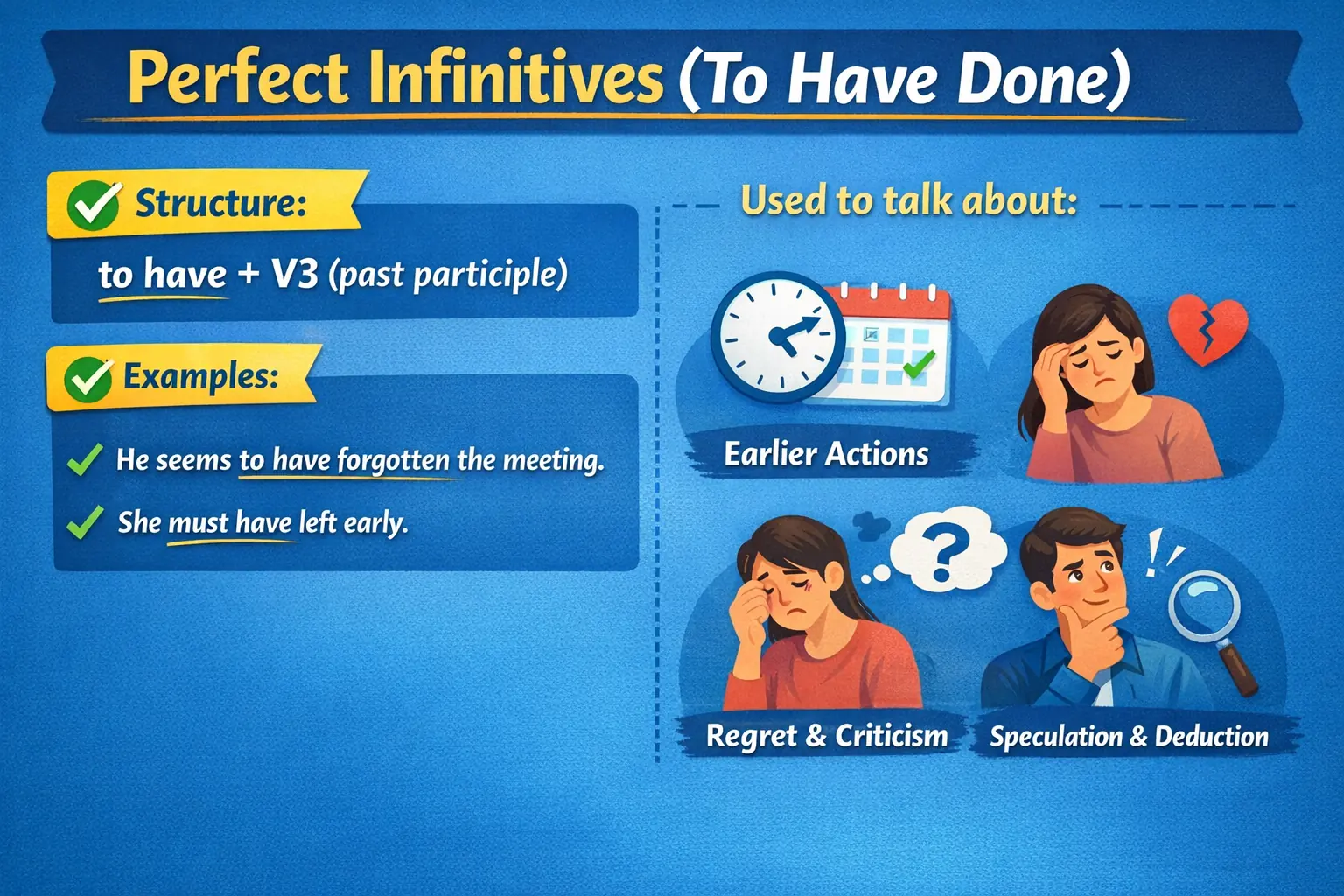
What Are Perfect Infinitives?
The perfect infinitive is a verb form that consists of ‘to have’ followed by the past participle of the verb. For instance, ‘to have eaten’, ‘to have gone’, and ‘to have seen’ are all examples of perfect infinitives. They are used when we talk about actions that were completed in the past but relate to another action or a time in the present or future.
What Is a Perfect Infinitive?
A perfect infinitive is a verb structure formed with “to have + past participle” (to have done, to have gone, to have seen). It is used to talk about an action that happened before another action, often expressing regret, criticism, speculation, or deduction.
Structure:
to have + V3 (past participle)
Examples:
- She seems to have forgotten the meeting.
- He must have left early.
- I am happy to have finished the project.
What's your English level?
Take the test and get your certificate!
Uses of Perfect Infinitives
Perfect infinitives are used in several contexts in English. Here are some of the most common uses:
- After Modal Verbs: Perfect infinitives often follow modal verbs such as ‘could’, ‘might’, ‘would’, ‘should’, etc., to express past possibilities, regrets, or speculations. For example, “I should have studied harder.”
- To Show a Completed Action: When an action has been completed before another time or action, perfect infinitives can attribute an earlier completion. For example, “She was happy to have finished her homework early.”
- Conditional Statements: Perfect infinitives can express hypothetical situations or conditions. For example, “If he were here, he would have understood.”
When Do We Use Perfect Infinitives?
Perfect infinitives are commonly used after:
1. Modal verbs (must, might, could, should)
- He must have missed the train.
- You should have told me earlier.
2. Adjectives expressing feelings
- She was happy to have completed the task.
- They were disappointed to have lost the game.
3. Reporting verbs (seem, appear, claim, pretend)
- He seems to have misunderstood the question.
- They claim to have solved the issue.
4. Passive constructions
- The report is believed to have been written in 2020.
Perfect Infinitive vs Perfect Gerund: What’s the Difference?
Perfect infinitive: to have done
Perfect gerund: having done
Difference:
- Perfect infinitive often follows another verb or adjective.
- Perfect gerund is typically used as a subject or after prepositions.
Examples:
- She denied having taken the money. (perfect gerund)
- She seems to have taken the money. (perfect infinitive)
Timeline Explanation: Why “Earlier Action” Matters
A perfect infinitive shows that one action happened before another reference point in time.
Example:
- He is happy to have finished the exam.
(Finishing happened before being happy.)
Negative and Passive Forms of Perfect Infinitives
Negative:
- He seems not to have understood the lesson.
Passive:
- The project is believed to have been completed successfully.
Perfect infinitive passive structure:
to have been + past participle
Examples of Perfect Infinitives in Sentences
To better understand how perfect infinitives function, let’s look at some sentences:
| Sentence | Explanation |
|---|---|
| He seems to have left early. | This indicates the action of leaving occurred and affects the current state or observation. |
| I was fortunate to have seen her perform. | This shows appreciation for an opportunity that happened in the past. |
| They claimed to have won the match. | Here, the focus is on reporting a past event. |
Common Mistakes with Perfect Infinitives
English learners might often confuse the use of perfect infinitives with simple infinitives. To master their usage, it’s important to recognize when a past action affects the present or when a hypothetical scenario in the past needs to be addressed. Make sure to use the correct past participle form of verbs to avoid grammar errors.
1. Using the wrong verb form
to have went
to have gone
2. Confusing past tense with perfect infinitive
He must went home.
He must have gone home.
3. Forgetting the auxiliary “have”
She seems to finished.
She seems to have finished.
Enhancing Your English with Perfect Infinitives
Understanding and practicing perfect infinitives can greatly improve your English language skills. They allow you to express nuances and time relations more accurately. Consider practicing by writing sentences using modal verbs and incorporating perfect infinitives to describe hypothetical past actions. Additionally, reading English literature and noticing where perfect infinitives are used will enhance your comprehension.
Practice Exercise: Choose the Correct Form
1. She cannot find her keys now; she seems ______ (forget) them at home.
a) to forget
b) to have forgotten
2. He must ______ (leave) already.
a) have left
b) left
Answers:
1. b) to have forgotten
2. a) have left
Quick Quiz: Test Your Understanding
Rewrite the sentence using a perfect infinitive:
“It appears that he stole the money.”
Correct answer:
He appears to have stolen the money.
Supporting Resources for Learning Perfect Infinitives
Here are some additional resources to enhance your understanding of perfect infinitives:
1. English Club
For comprehensive definitions and examples, visit English Club.
2. Cambridge Dictionary
Explore the use of perfect infinitives in different contexts with detailed explanations and examples at Cambridge Dictionary.
3. British Council
Access excellent learning materials at British Council for deeper insights into English grammar and perfect infinitives.
You can check your English level using the GET Global English Test.
What's your English level?
Take the test and get your certificate!