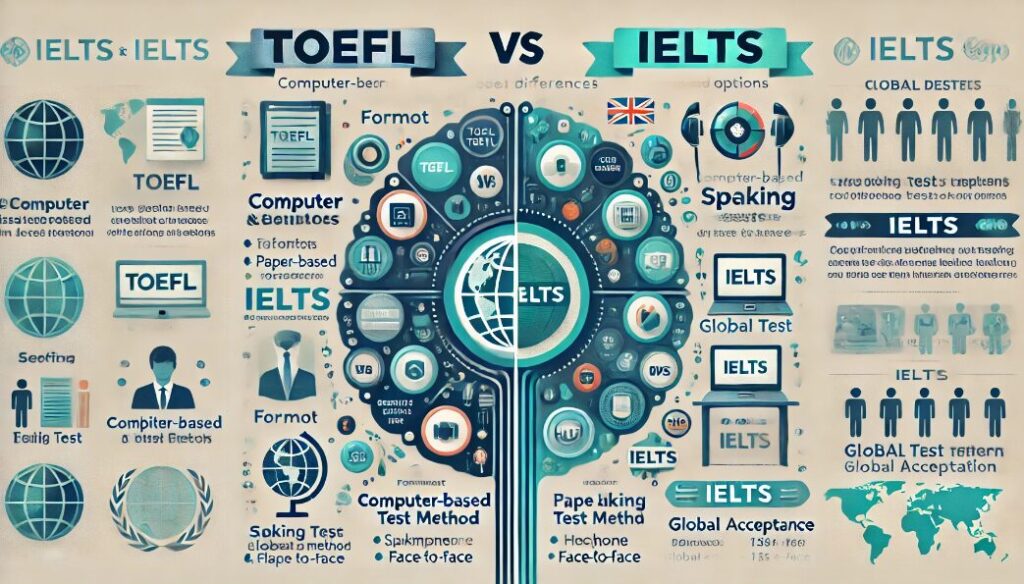
Choosing between TOEFL (Test of English as a Foreign Language) and IELTS (International English Language Testing System) is a critical decision for non-native English speakers planning to study, work, or immigrate abroad. Both tests assess your English proficiency, but they differ significantly in format, cost, acceptance, and more. Here’s a comprehensive comparison to help you decide.
What's your English level?
Take the test and get your certificate!

1. Global Recognition and Acceptance
- TOEFL: Widely accepted by universities in the United States and Canada. Many institutions in Europe, Asia, and Australia also recognize TOEFL scores.
- IELTS: Accepted worldwide by universities, employers, and immigration authorities. It is particularly preferred in the UK, Australia, and New Zealand.
Verdict: Choose a test accepted by your specific university or programme; country alone does not determine the right test.
2. Test Format
- TOEFL: Internet-based (TOEFL iBT) and consists of Reading, Listening, Speaking, and Writing sections. The Speaking section requires you to respond to prompts through a microphone, which is then evaluated later.
- IELTS: Available in two formats: Academic and General Training. The test includes Reading, Listening, Writing, and Speaking sections. The Speaking test is conducted as a face-to-face interview with an examiner.
Verdict: TOEFL is better for tech-savvy test-takers, while IELTS suits those who prefer human interaction in the Speaking test.
3. Difficulty Level
- TOEFL: Questions are often more academic, with complex vocabulary and integrated tasks. Ideal for those with strong academic English skills.
- IELTS: Task types differ from TOEFL. Try official samples to see which format suits your skills; neither test is universally easier.
Verdict: Base your choice on accepted evidence and your experience with official sample tasks.
4. Test Duration
- TOEFL iBT: Allow approximately 2 hours for the current test.
- IELTS: 2 hours and 45 minutes.
Verdict: The current TOEFL iBT is shorter; compare the format and timing that suit you.
5. Scoring System
- TOEFL iBT: Overall and section scores use a 1 to 6 scale from 21 January 2026. The overall score is the average of the four sections, rounded to the nearest half band.
- IELTS: Scores range from 0 to 9 bands, with half-band increments.
Verdict: Both use band scales; compare the exact overall and skill scores required by your recipient.
6. Cost
- TOEFL: Costs vary by country, typically ranging from $190 to $250.
- IELTS: Generally priced between $215 and $250.
Verdict: Both are similarly priced; check the specific fees in your region.
7. Test Locations and Availability
- TOEFL: Available in over 150 countries with numerous test dates.
- IELTS: Equally accessible worldwide, with both paper-based and computer-based options.
Verdict: Both offer extensive global availability, but IELTS provides flexibility with test formats.
8. Validity Period
- TOEFL: Scores are valid for 2 years.
- IELTS: Also valid for 2 years.
Verdict: No difference here.
9. Preparation Resources
- TOEFL: ETS offers official practice tests, free resources, and apps.
- IELTS: British Council, IDP, and Cambridge provide official preparation materials and mock tests.
Verdict: Ample preparation resources are available for both, but choose based on the test you’re more comfortable with.
10. Immigration Requirements
- TOEFL iBT: Not on the Express Entry English-test list or UKVI SELT list. Australian visa use requires the approved Australia registration pathway and test-centre conditions.
- IELTS: Choose the exact accepted version: for example, General Training for Express Entry or the required UKVI-approved version for a UK SELT route.
Verdict: Check your route’s approved test, format, result age and scores before booking.
Both TOEFL and IELTS are excellent tests to demonstrate your English proficiency. Your choice should depend on your specific goals, the test’s acceptance in your target country or institution, and your personal preferences regarding test format and difficulty. Take time to evaluate which aligns better with your strengths and aspirations.
Good luck with your English proficiency journey!
Scale checked on 5 September 2026: ETS TOEFL iBT score update. The 1 to 6 scale applies from 21 January 2026; reports also include a comparable 0 to 120 overall score during the two-year transition.
Checked on 5 September 2026: current TOEFL format, IRCC Express Entry, UKVI SELTs, Australian visa English evidence.
What's your English level?
Take the test and get your certificate!